THE CALCULATION
Desired servings ÷ original servings = ingredient multiplier. Multiply each suitable ingredient amount by that number. Keep cooking time, temperature, pan capacity and purchase pack sizes as separate decisions.
Begin with the portions you actually want.
Check the recipe’s original yield before touching the amounts. Four servings might mean four main dishes, four side portions or a batch of twelve small pieces. Decide what the food will be in your meal. A serving label is a recipe author’s portion assumption, not a guarantee that every eater wants the same amount.
Include any deliberately planned extra portions. If two people are eating tonight and one portion is intended for a later lunch, your target is three. Then divide the target by the original yield. Three divided by four is 0.75; two divided by four is 0.5; six divided by four is 1.5.
Write the multiplier once at the top of your working copy. Keep the original visible until you have checked the whole ingredient list. This is particularly helpful with saved or imported recipes, where the displayed serving count and an amount written inside a step might not have been updated together.
Use one multiplier throughout the ingredient list.
Suppose a four-serving pasta recipe uses the amounts below and you want three servings. Every value in the final column is the original amount multiplied by 0.75. This table illustrates arithmetic; use the complete recipe’s method when cooking.
| Ingredient | For four servings | Calculation | For three servings |
|---|---|---|---|
| Dry pasta | 400 g | 400 × 0.75 | 300 g |
| Chopped tomatoes | 600 g | 600 × 0.75 | 450 g |
| Frozen peas | 200 g | 200 × 0.75 | 150 g |
| Olive oil | 2 tablespoons | 2 × 0.75 | 1½ tablespoons |
Check every line rather than only the expensive ingredients. It is easy to halve the pasta and leave the full quantity of sauce or dressing by accident. Also inspect subrecipes: a dressing may have its own ingredient list even when the main recipe refers to it as a single component.
Keep units attached to the values. “150” is not a usable instruction without knowing whether it means grams, millilitres or something else. If you convert between kilograms and grams, finish the conversion before combining totals. Do not use a generic weight-to-volume conversion for different ingredients.
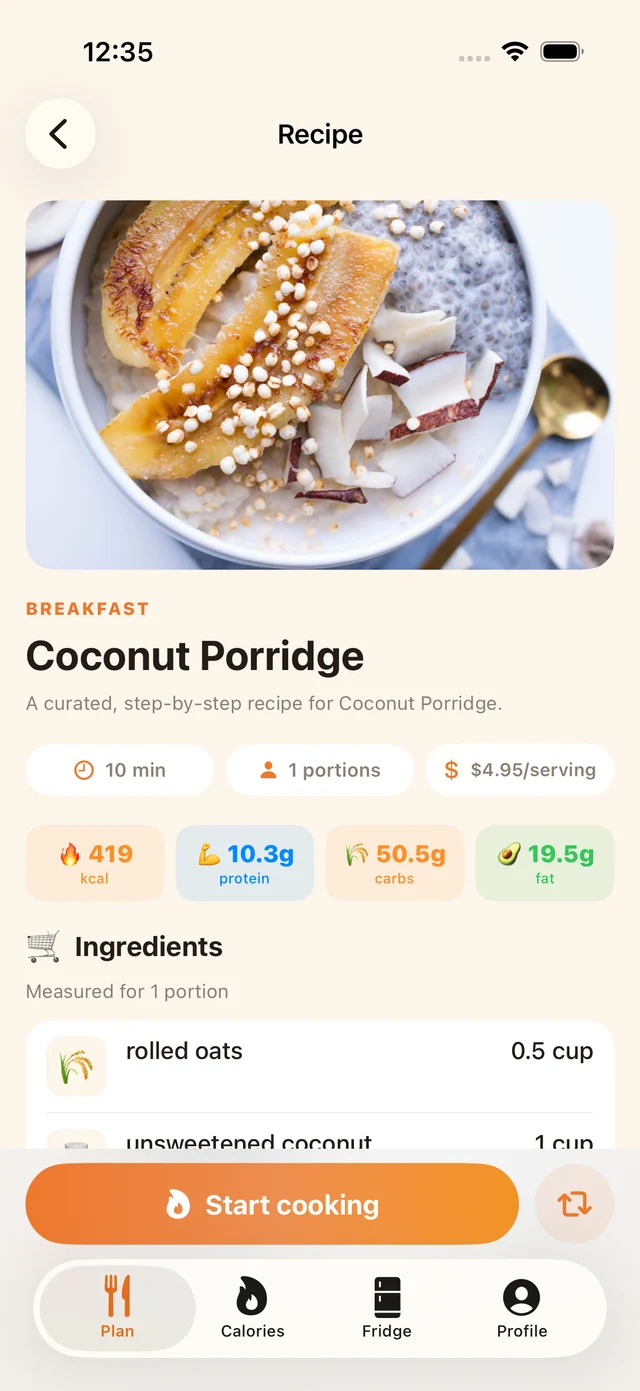
This MealPot example labels its ingredients for one portion. The displayed price is an example app estimate, not a current supermarket basket quotation.
Leave awkward amounts visible until you decide.
A multiplier can produce half an onion, three-quarters of a pepper or one-and-a-half eggs. For a flexible savoury dish, decide whether a modest adjustment is appropriate to the method and your preferences. Record what you choose so the recipe remains understandable next time.
For a recipe whose texture depends on precise ratios, a convenient rounding choice can change the result. Baking, confectionery and recipes with a carefully balanced set can need more than simple portion arithmetic. Prefer a tested version for the intended yield and tin size rather than assuming that every recipe tolerates the same change.
Ingredients listed “to taste” remain a judgement call. For seasoning in a savoury dish, begin cautiously and adjust where the cooking method allows safe tasting. Do not manufacture an exact number for a missing quantity. If an import has lost the salt amount, the right next step is to inspect the source, not to guess that the blank means zero.
The pan and timer do not use the same formula.
Doubling ingredients does not automatically double cooking time, and halving them does not automatically halve it. The size of individual pieces, the depth of food in the vessel and how crowded the pan becomes all affect the cooking process. Follow the recipe’s relevant doneness guidance and appropriate food-safety guidance for the food you are preparing.
Read the method with the larger or smaller batch in mind. Will everything fit without crowding? Does the recipe rely on browning in a single layer? Can you stir safely? Cooking two batches in the intended pan may be more predictable than filling one pan beyond the conditions the recipe describes.
Liquids also deserve attention. Water used to boil pasta is not the same kind of quantity as stock absorbed into a rice dish. Evaporation depends on the vessel and cooking conditions. Keep the method’s instructions in view instead of assuming that every volume on the page behaves identically.
If you want many more servings than the original recipe makes, choose a recipe designed for that batch size or divide the work into suitable batches. A calculator can supply arithmetic; it cannot establish that the new cooking setup is appropriate.
Combine scaled needs, then choose packs.
Build your shopping list from the adjusted ingredients. If the three-serving dish needs 300 g of dry pasta and another meal needs 150 g, the combined requirement is 450 g. Subtract usable pasta already at home before deciding what to buy.
A 500 g pack might cover that requirement, but the recipe still needs its calculated 300 g. Do not change the meal’s portion count simply because the shop sells a larger bag. Keep the spare 50 g as stock or give it a future use. The pack-size guide explains this distinction in detail.
Use the same care when changing a plan later. Removing one serving from Tuesday changes Tuesday’s ingredients, not every appearance of those ingredients across the week. Recalculate the affected recipe, then rebuild its contribution to the combined aisle list.
Common questions
Does doubling a recipe double its cooking time?
No. Pan size, food depth, individual piece size and cooking method matter. Review the method and appropriate doneness guidance instead of multiplying the timer.
Can I combine cooked and dry ingredient weights?
Keep them separate unless you have a recipe-specific basis for converting them. Cooked rice and dry rice, for example, are different forms with different water content.
When should I change servings in a meal planner?
Set the desired servings before combining ingredients into the shopping list. Check the resulting quantities and any amounts embedded in the instructions, particularly for imported recipes.