THE PACK-SIZE CHECK
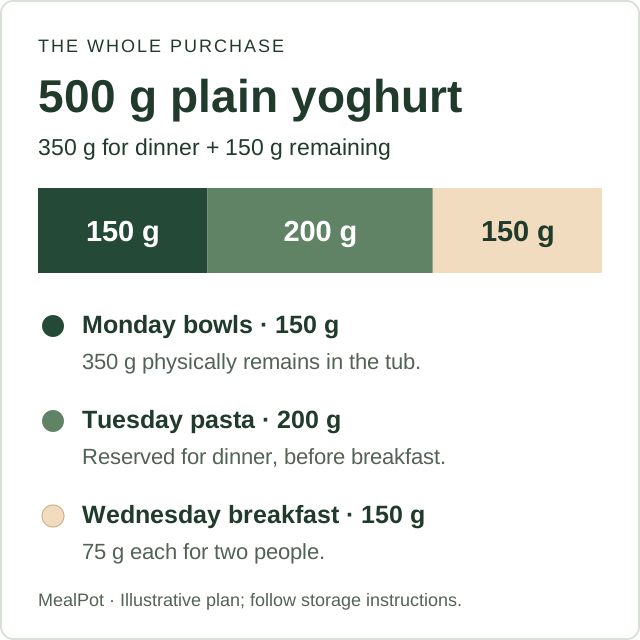
Add what your planned meals need. Subtract usable stock. Choose packs that cover the shortfall, then give the excess a specific use or a place in storage. A 500 g yoghurt tub covering 350 g of planned meals leaves 150 g to account for.
Keep recipe need, purchase and remainder separate.
Suppose Monday’s dinner needs 150 g of plain yoghurt. Buying a 500 g tub does not change the recipe to 500 g. After that dinner, 350 g remains physically in the tub. If Tuesday’s dinner already needs 200 g, however, only 150 g is unallocated. The other 200 g already has a job.
That distinction matters when somebody opens the fridge looking for breakfast. Food can still be in a pack while already being reserved for a later meal. Write down both the total need and what will be left after the whole plan.
- Total need: add the quantities for the servings you will actually cook.
- Available stock: count food that is suitable to use and available for these meals, excluding anything reserved elsewhere.
- Still to buy: subtract available stock from total need. If stock already covers it, buy zero.
- Remainder after the plan: available stock plus the usable quantity purchased, minus total need.
For equal-size packs, divide the shortfall by the usable amount in one pack and round up to a whole number of packs. Then compare other sizes or loose options. Rounding up tells you what covers the need; it does not tell you which purchase best fits your budget or kitchen.
Work through two dinners for two people.
In this illustrative household plan, Monday’s chickpea and pepper bowls use 150 g yoghurt, 240 g drained chickpeas and two peppers. Tuesday’s pea pasta uses 200 g yoghurt, 200 g dry pasta and 150 g frozen peas. These are quantities for the whole household meal, not per person. They are a shopping example, not complete recipes: seasoning, cooking ingredients and any accompaniments sit elsewhere on the list.
The cupboard contains 100 g dry pasta, all available for Tuesday. There is no available stock of the other four ingredients. Proposed pack sizes below are examples; use the quantities on the actual products in your shop.
| Ingredient and form | Meal need | Available stock | Still to buy | Proposed purchase | After both dinners |
|---|---|---|---|---|---|
| Plain yoghurt | 150 + 200 = 350 g | 0 g | 350 g | 1 × 500 g tub | 150 g |
| Dry pasta | 200 g | 100 g | 100 g | 1 × 500 g pack | 400 g |
| Whole peppers | 2 | 0 | 2 | 1 × 3-pepper pack | 1 pepper |
| Frozen peas | 150 g | 0 g | 150 g | 1 × 500 g bag | 350 g |
| Drained chickpeas | 240 g | 0 g | 240 g | 1 tin: 400 g net, 240 g drained | 0 g chickpeas |
The pasta row is easy to misread. Tuesday uses the existing 100 g plus 100 g from the new pack. That leaves 400 g in the new pack, not 300 g: the 200 g dinner requirement was partly covered before shopping. A smaller pack, if available, could cover this shortfall with less stock to store. Loose peppers could cover exactly two.
Compare quantities in the same form.
Before adding ingredient rows, make their units and preparation states agree. A precise sum of incompatible numbers is still the wrong shopping quantity.
- Dry and cooked: the example’s 200 g pasta need is dry weight. Do not subtract 100 g cooked pasta as if they were interchangeable. Use cooked leftovers in a suitable dish, with a separate quantity.
- Grams and millilitres: convert 0.5 kg to 500 g directly. Do not treat 200 ml of every ingredient as 200 g; volume-to-weight conversion depends on the ingredient. A recipe given in tablespoons may need weighing or an ingredient-specific conversion before comparing it with a tub.
- Whole and prepared produce: two whole peppers is a count. A recipe asking for 200 g trimmed pepper needs edible flesh, so two peppers of unknown size are not a guaranteed match.
- Net and drained: a tin labelled 400 g net and 240 g drained supplies 240 g chickpeas when the liquid is discarded. For a 350 g drained requirement, one tin falls 110 g short. Two such tins supply 480 g and leave 130 g.
Use the product’s own drained weight; the 400/240 g relationship here is an example, not a conversion rule for all tins. If the recipe uses the liquid too, record that use separately. A multipack containing four 125 g pots supplies 500 g in total, but the individual pots’ opening and storage needs may make it a different practical choice from one large tub.
Give the remaining food a date and an amount.
Turn the final column into instructions someone in the household could follow. A second use should fit a meal you want to eat and have the other ingredients for. “Find a recipe later” leaves the planning unfinished.
| Food remaining | Allocation | What remains afterwards |
|---|---|---|
| 150 g yoghurt | Wednesday breakfast: 75 g each with the usual breakfast, if the label allows this timing. | 0 g |
| 1 pepper | Tuesday pasta: slice and cook it as an added vegetable in the planned dish. | 0 peppers |
| 400 g dry pasta | Keep sealed as cupboard stock. Reserve 200 g for the next planned two-person pasta dinner. | 200 g after that later dinner |
| 350 g frozen peas | Keep frozen. Reserve 150 g for that later pasta dinner. | 200 g after that later dinner |
Once the pepper is assigned to Tuesday, update Tuesday’s recipe note and the plan’s pepper requirement from two to three. The purchase stays at one three-pack, but the expected unallocated remainder becomes zero. Do not add the same pepper again to the shopping list as a new ingredient.
The later dinner does not need to finish the entire pasta pack and pea bag. Properly stored stock can carry into another shop. The purpose is to avoid forgotten purchases, not to force every ingredient into this week’s meals.
Let storage instructions set the timetable.
For the yoghurt, read the date and any instruction to consume within a stated time after opening before committing to Wednesday. If that timing does not work, move its next use earlier or choose a smaller purchase. UK guidance distinguishes use-by dates, which concern safety, from best-before dates, which concern quality; follow storage instructions, including those after opening. See the official explanation of food dates.
Unused ingredients and cooked leftovers need separate decisions. For cooked leftovers, the Food Standards Agency advises cooling and refrigerating within one to two hours, then eating within 48 hours or freezing. Its guidance also says to transfer unused canned food to a covered container and refrigerate it, and to follow freezing instructions on the pack. See FSA chilling and freezing guidance, which applies to England, Northern Ireland and Wales; follow your local authority’s advice elsewhere.
A cheap portion can still require a larger checkout.
Use the yoghurt in the same two-dinner example. Imagine a 250 g tub costs €1.20 and a 500 g tub costs €1.80. These prices are illustrative, not a retailer quote. Assume equivalent plain yoghurt that suits both dishes.
| Purchase covering 350 g | Checkout spend | Price per 100 g | Cost allocated to 350 g used | Value in 150 g remaining |
|---|---|---|---|---|
| 2 × 250 g at €1.20 | €2.40 | €0.48 | €1.68 | €0.72 |
| 1 × 500 g at €1.80 | €1.80 | €0.36 | €1.26 | €0.54 |
Here the larger tub costs €0.60 less at checkout than two smaller tubs, and both purchases leave the same 150 g. On the €1.80 tub, Monday’s 150 g accounts for €0.54 and Tuesday’s 200 g for €0.72. The two dinners therefore use €1.26 of yoghurt. The other €0.54 is still in the fridge until the breakfast is eaten. You pay €1.80 when buying the tub, regardless of how a recipe-cost estimate divides it.
Change the need and the decision changes. If the household needs only 200 g, one 250 g tub covers it for €1.20 and leaves 50 g. The 500 g tub costs €0.60 more today and leaves 300 g. Its €0.36 unit price is lower, and the allocated cost of its 200 g portion is €0.72, but that does not make the checkout cheaper.
If all 300 g of that larger tub’s remainder were discarded, the household would have spent €1.80 to eat 200 g: an effective spend of €0.90 per 100 g eaten. That conditional calculation shows why expected use matters. It is not a measured waste result or a prediction about your household.
For the weekly budget, total full packs you will actually buy, other groceries and any fees. For the cost of a meal, allocate the ingredients it uses, including cupboard ingredients at a known or estimated purchase cost. Cupboard food needs no new checkout payment today, but it did not necessarily cost nothing. The store-agnostic planning guide explains how to compare the whole shop.
When the week changes, change the allocation.
If Tuesday’s pasta is cancelled after Monday’s bowls, 350 g yoghurt remains in the tub. The planned 150 g breakfast still leaves 200 g without a use. Move a suitable meal into the available storage window, assign another familiar use or revise breakfast quantities if people actually want more. Freezing is an option only when the food and product instructions allow it. A cancelled dinner is a reason to revisit the quantities.
After both original dinners have been cooked, and before the next shop, count the remaining pasta and peas. If you have also made the later dinner, they should be 200 g of each in this example. Otherwise they should still be 400 g pasta and 350 g peas. Start from what is there, rather than subtracting a meal that never happened.
If the same fresh ingredient repeatedly goes unused, try a smaller pack, loose produce or a different meal. A larger pack can be sensible for food you regularly use and can store; it can also tie up money and space. The calculation makes those consequences visible without guaranteeing a particular saving or reduction in waste.
Take the calculation to your next shop.
Download the printable pack-size worksheet, or open it to print. It has space for three ingredients, their units, available stock, packs, remaining quantity and next use. Print on A4 portrait with “fit to page”, or copy the fields into your notes. Start with three ingredients that often leave an awkward remainder.
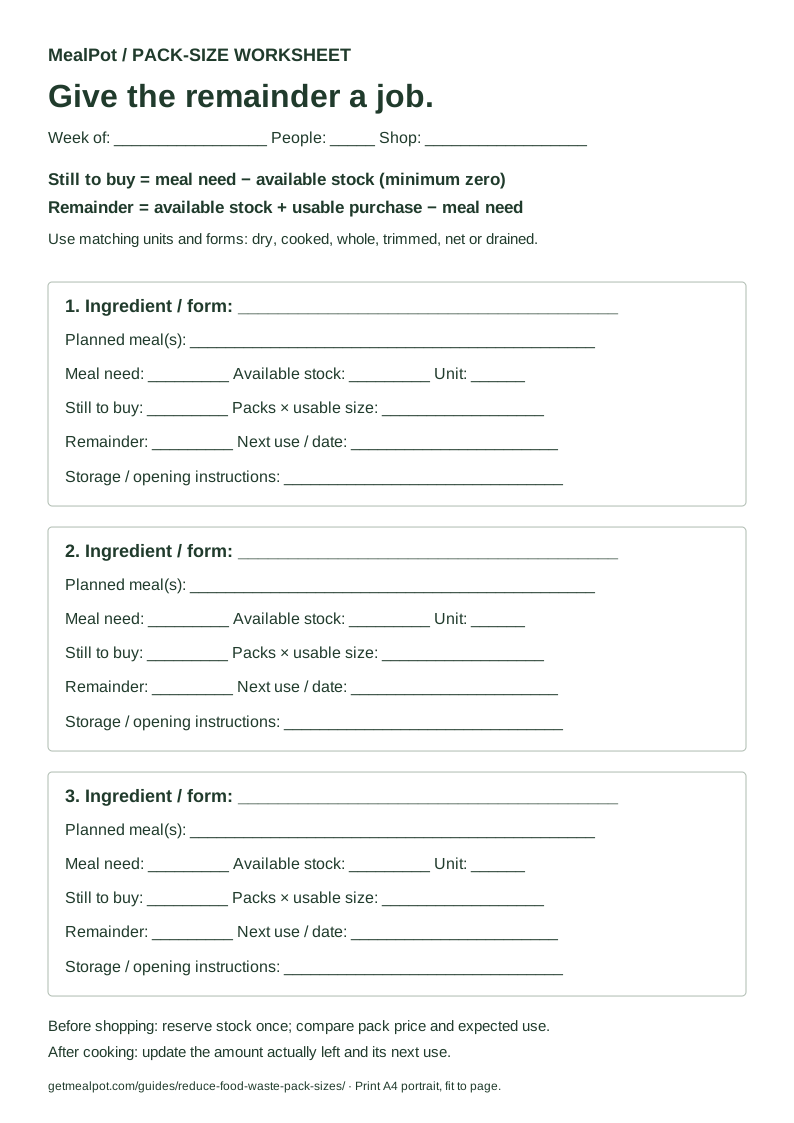
After changing meals or serving counts, update the combined shopping list. Keep the remainder plan beside the dinners so each reserved ingredient is visible when someone cooks.
Common questions
Should I cook the whole pack to avoid leftovers?
Only if the quantity fits the recipe, cookware and your plans for the cooked food. A larger pack does not automatically justify increasing dinner portions. Suitable unused stock may be easier to manage than another cooked meal.
Is the biggest pack always the best value?
No. Compare total price, the amount needed, storage and how much you expect to eat. In the yoghurt example, a 500 g tub is the cheaper purchase for a 350 g need; a 250 g tub requires less money for a 200 g need.
Can I combine every row with the same ingredient name?
Combine only compatible forms and units. Dry and cooked pasta are different quantities. A tin’s net weight and its drained contents are different quantities. Plain and vanilla yoghurt may not suit the same dishes even when both are sold by weight.
Can a recipe cost estimate tell me my grocery bill?
Not by itself. It may allocate the cost of only the amount used, while the shop charges for the whole pack. Add your actual purchases to estimate checkout spend.
Make the next shop work with what is here.
Try a smaller planning routine if a full week feels like too much.