WHAT STORE-AGNOSTIC MEANS
Your plan is expressed as meals, ingredients and quantities that remain useful when you change shops. Buying those ingredients is a separate step. A portable list does not imply a live connection to every retailer or a guaranteed grocery price.
Start with ingredients that survive a change of shop.
“400 g chopped tomatoes” is useful in a supermarket, a neighbourhood grocery shop or an online store. A link to one retailer’s particular tin may stop being useful if that product disappears or you shop elsewhere. Keep the ingredient requirement as your main record and treat product choices as the way you fulfil it.
Start by choosing meals and setting their portions. Combine matching ingredient amounts, then subtract the usable food already at home. The aisle shopping-list guide shows the full sequence. Once those calculations are done, the same list can travel to a different shop without requiring you to plan dinner again.
Write enough detail to distinguish ingredients that look similar. “Rice” may need to be “dry risotto rice” when the cooking method depends on it. “Beans” may need a drained weight and variety. Portability comes from a clear requirement, not from stripping away every detail.
Separate flexible choices from essential ones.
Some product details are preferences; others are requirements. You might accept any own-brand chopped tomatoes while needing a specific dietary specification for another ingredient. Record what matters before you shop or share the list. The person choosing products should not have to infer which substitutions are acceptable.
For allergies and dietary restrictions, check the actual product label and the information provided for the product you are buying. An ingredient name or a planner’s filter is not a substitute for checking a different brand. If a proposed replacement does not satisfy a requirement, leave it out or choose a different meal you can make appropriately.
| List entry | Useful flexibility | Check before choosing |
|---|---|---|
| 400 g chopped tomatoes | Different brands or suitable pack combinations | Amount and any required ingredients or exclusions |
| 240 g drained chickpeas | A suitable tin or jar | Drained weight rather than total weight |
| 300 g dry pasta | A shape appropriate to the sauce | Dietary specification and cooking instructions |
| Spinach for a cooked filling | Fresh or frozen if the recipe supports it | Preparation, moisture and the quantity the method needs |
Make the product match in the shop.
Suppose your recipes need 450 g of pasta and you have none. A 500 g pack could cover the requirement. Two 250 g packs could also cover it. The appropriate choice depends on availability, total price, dietary requirements and whether you want more pasta in the cupboard.
Keep “450 g needed” visible while comparing products. It is easy to lose track of the requirement after opening several product pages. If an online shop suggests a smaller pack, update the pack count yourself where necessary. If it suggests a larger pack, decide whether the extra is useful before accepting.
When a product is unavailable, return to its role in the recipe. A different pasta shape may be a straightforward choice. A replacement for a key sauce ingredient may change the dish substantially. If you cannot make a suitable substitution with confidence, changing that meal can be simpler than forcing a poor match.
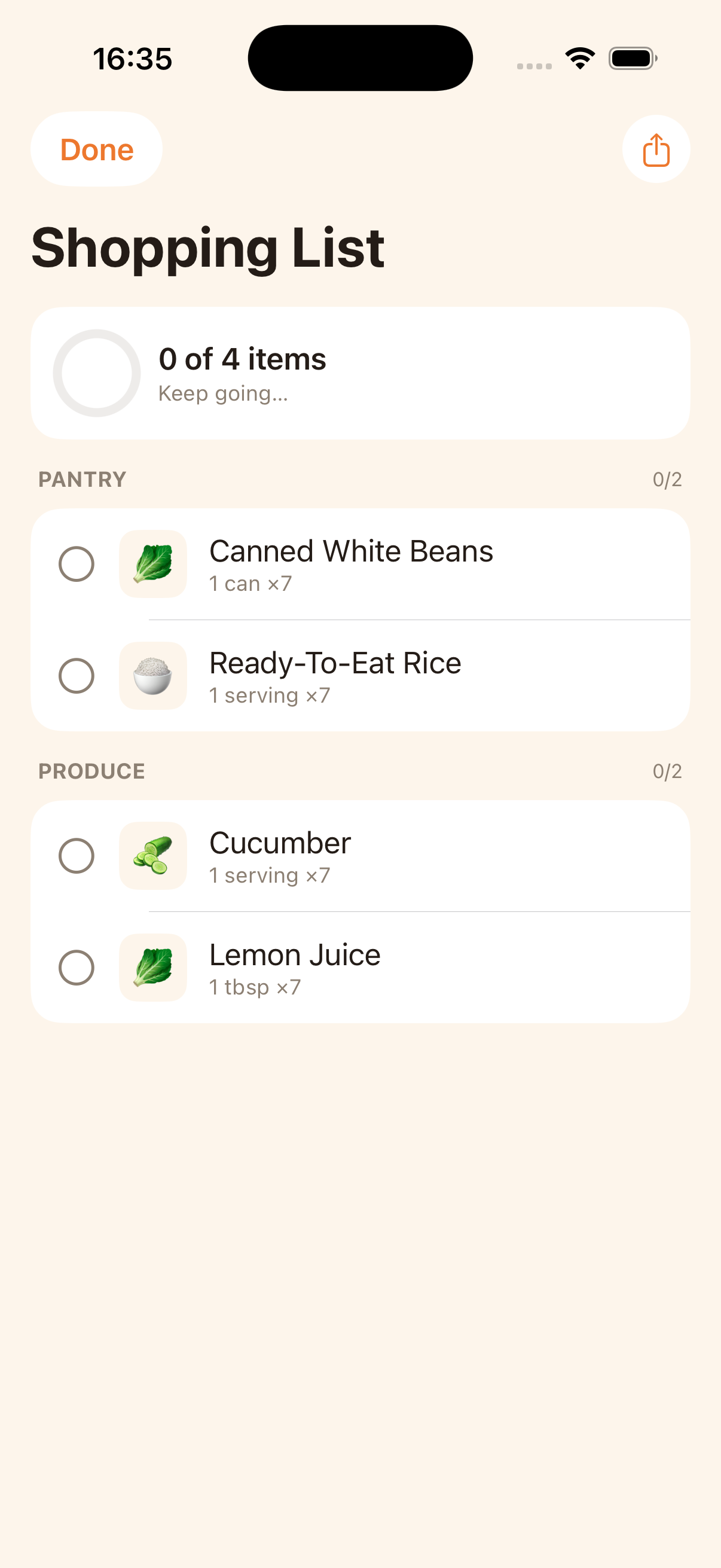
This MealPot screen shows ingredient entries grouped for shopping. It does not show a connected retailer basket, confirmed stock or a checkout total.
Compare the money you will actually spend.
A recipe cost and a shopping bill answer different questions. A recipe may use a fraction of a bottle of oil, while the checkout charges for the whole bottle if you need to buy one. Compare the packs you intend to purchase, not only estimated ingredient costs per portion.
For illustration, imagine one basket costs €28 for groceries plus €4 delivery, while another costs €31 with collection available at no extra fee. The first grocery subtotal is lower; its €32 payable total is higher before accounting for your collection journey. These are invented arithmetic examples, not current retailer offers.
Include service fees, delivery charges, minimum-order rules and any promotional conditions shown at checkout. A multi-buy may reduce the unit price while increasing this week’s spending. The pack-size worksheet helps decide whether the extra quantity has a realistic use.
You do not need to split every shop across several retailers to benefit from a portable list. Visiting a second shop costs time and may add travel expense. One familiar shop with acceptable options can be the more workable choice for the week you actually have.
Treat grocery delivery as its own decision.
A planner may offer a grocery handoff, but the delivery service still needs to support your address and chosen shop. Check the actual retailer, product matches, pack counts, substitution settings and final total before placing an order. A button in a planner is the beginning of that check, not proof that the basket is ready.
If you are comparing Mealime-related delivery options, preserve a readable list as well as any retailer links. That gives you a way to keep shopping when you change services. This website’s recipe backup tool creates a copy of a recipe; it does not place a grocery order or connect your account to a delivery service.
After shopping, update the meal plan only where a real substitution changes it. Keep the reusable recipe and ingredient requirements intact. Next week you can choose a different shop without starting the planning work again.
Common questions
Can I take a meal-planner shopping list to Aldi, Tesco or Walmart?
A readable list of ingredients and quantities can be used in the shop you choose. Check local products and pack sizes yourself. That is different from claiming an online ordering integration with those retailers.
Does a store-agnostic planner find the cheapest basket automatically?
That does not follow from a portable list. Automatic price comparison would be a separate feature requiring current retailer data. Compare the actual packs and checkout charges yourself unless a service explicitly supplies that information.
Should I keep brand names off the list?
Keep them when they matter to your preference, dietary requirement or recipe. Mark where another suitable product is acceptable so the list remains useful when availability changes.